Dying Satellites Could Lead to Shaky Weather Forecasts

Dying Satellites Could Lead to Shaky Weather Forecasts - NYTimes.com: "The United States is facing a year or more without crucial satellites that provide invaluable data for predicting storm tracks, a result of years of mismanagement, underfunding and delays in launching replacements, according to several recent official reviews.

The looming gap in satellite coverage, which some experts now view as almost certain to occur within the next few years, could result in shaky forecasts about storms like Hurricane Sandy, which is now expected to hit the northeast seaboard early next week."

Glitch halts South Korea's third attempt at rocket launch

Glitch halts South Korea's third attempt at rocket launch | Reuters: "South Korea called off the launch of a space rocket on Friday after a glitch in the Russian-built booster halted preparations five hours before the scheduled lift-off.

It was South Korea's third attempt to put a satellite into orbit and comes after North Korea succeeded in launching a rocket in April that it said was carrying a satellite, only to abort the mission early in its flight.

Friday's failure also puts South Korea far behind economic rivals China, India and Japan.

South Korean officials at the Korea Aerospace Research Institute (KARI) that is conducting the launch said Russian engineers had found a leak in the sealing while injecting helium gas into the first-stage booster."

Fomalhaut b regains planetary status

Fomalhaut b regains planetary status | TG Daily: "The nearby star Fomalhaut does host a massive exoplanet after all, say NASA scientists following a second look at Hubble data.
Back in 2008, astronomers announced that they'd discovered a planet, named Fomalhaut b, shrouded by dust as it orbited Fomalhaut some 25 light-years away.

More recent studies, though, have claimed that this interpretation is wrong. Based on the object's apparent motion and the fact that NASA's infrared Spitzer Space Telescope failed to detect it, they argue that the object is a short-lived dust cloud unrelated to any planet.

Now, though, NASA says that the original theory was probably correct."

Cassini Sees Huge Burp at Saturn After Large Storm

NASA - NASA Spacecraft Sees Huge Burp at Saturn After Large Storm: "NASA's Cassini spacecraft has tracked the aftermath of a rare massive storm on Saturn. Data reveal record-setting disturbances in the planet's upper atmosphere long after the visible signs of the storm abated, in addition to an indication the storm was more forceful than scientists previously thought.

Data from Cassini's composite infrared spectrometer (CIRS) instrument revealed the storm's powerful discharge sent the temperature in Saturn's stratosphere soaring 150 degrees Fahrenheit (83 kelvins) above normal. At the same time, researchers at NASA's Goddard Space Flight Center in Greenbelt, Md., detected a huge increase in the amount of ethylene gas, the origin of which is a mystery. Ethylene, an odorless, colorless gas, isn't typically observed on Saturn. On Earth, it is created by natural and man-made sources. "

Secret X-37B Mini-Shuttle Launch Postponed

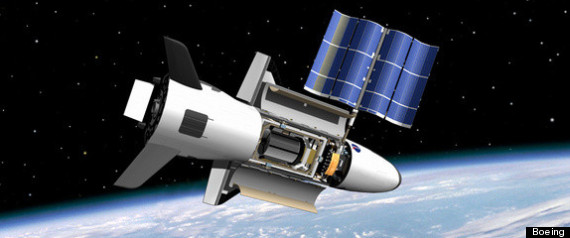
Brevard Times - Space: Secret X-37B Mini-Shuttle Launch Postponed: "The X-37B Orbital Test Vehicle (OTV), the Air Force's unmanned, reusable space plane, has been re-scheduled to launch aboard a United Launch Alliance (ULA) Atlas V booster rocket from Cape Canaveral Air Force Station on November 13, 2012 due to a chamber pressure anomaly observed during the Delta IV medium configuration launch of a Global Positioning Satellite (GPS) IIF-3 on October 4, 2012.

While the mission successfully placed the GPS satellite in a precise orbit, a lower than normal chamber pressure was observed on the Delta IV RL 10 upper stage engine.

Although the Atlas V that will launch OTV-3 utilizes a different model of the RL10 engine, ULA leadership and the Air Force have decided to postpone the currently schedule launch to allow an additional two weeks for the flight data anomaly investigation to progress to a point that will enable a thorough crossover assessment for the OTV launch to be completed."

European Robotic Mini-Space Plane Project Could Fly by 2020

European Robotic Mini-Space Plane Project Could Fly by 2020 | Space.com: "A European-built robot space plane could be soaring in orbit before the end of the decade if the program to develop it gains funding approval next month.

The Innovative Space Vehicle (ISV) would be Europe's civilian equivalent of the U.S. Air Force's unmanned X-37B Orbital Test Vehicle, a robotic miniature space shuttle that has flown on two missions since 2010. The unmanned space plane would be much smaller than the Air Force vehicle, however."

Frost on Mars? Curiosity uses its laser to probe mystery

Frost on Mars? Curiosity uses its laser to probe mystery (#PewPew) - latimes.com: "The Mars Curiosity rover, cozy at the sandy, windblown patch of ground called Rocknest, pulled out its laser late last week, aimed it at a target about 9 feet away and started zapping.

The goal? To find out whether frost accumulates on Mars' surface at night, according to Roger Wiens of Los Alamos National Laboratory.

"The idea was to take one measurement of Crestaurum at night and one during the day for comparison," the scientist and principal investigator for Curiosity's ChemCam instrument told the Los Angeles Times."

SpaceX Dragon OK'd to come home despite computer glitch

SpaceX Dragon OK'd to come home | FLORIDA TODAY | floridatoday.com: "SpaceX’s Dragon capsule on Sunday is set to end an 18-day stay at the International Space Station and return to Earth, NASA confirmed Wednesday.

Station mission managers unanimously gave a “go” for the departure to proceed despite a glitch that may make one of Dragon’s three flight computers unavailable.

The computer was knocked out of sync with the other two when it automatically reset itself without commands from the ground, but officials said the problem would not limit the spacecraft’s ability to fly home safely."

Soyuz successfully docks with International Space Station

Soyuz successfully docks with International Space Station | FLORIDA TODAY | floridatoday.com: "An American and two Russians arrived at the International Space Station today after a two-day trip from a central Asian spaceport.

NASA astronaut Kevin Ford and cosmonauts Oleg Novitskiy and Evgeny Tarelkin docked at the Poisk module on the Russian side of the station at 8:29 a.m. EDT.

“A flawless approach. A flawless docking,” NASA mission commentator Rob Navias said. “Three new residents have arrived at the International Space Station.”"

Robot to be controled from Space Station

The next step in human exploration of the solar system will probably involve astronauts controlling rovers on the surface of the moon, mars or an asteroid from a vehicle orbiting above.  NASA and ESA plan to test this concept next week when an astronaut aboard the ISS will operate a robot on earth.

ESA - ESA Spacecraft Operations - Using space internet to control robots: "ESA and NASA have tested a communications protocol that will allow astronauts to control robots from space stations orbiting planets or asteroids. The test marks the way for a trial-run with an astronaut on the International Space Station next week.

Last week a Space Station user centre at the University of Boulder, USA sent a command to a NASA laptop on the International Space Station to start a script that controlled the Mocup robot at ESA’s ESOC operations centre in Darmstadt, Germany.
 "

Keck observations reveal complex face of Uranus

Keck observations reveal complex face of Uranus: "The planet Uranus, known since Voyager’s 1986 flyby as a bland, featureless blue-green orb, is beginning to show its face.

By using a new technique with the telescopes of the Keck Observatory, astronomers have created the most richly detailed, highest-resolution images ever taken of the giant ice planet in the near infrared, revealing an incredible array of atmospheric detail and more complex weather.

The planet, in fact, looks like many of the solar system’s other large planets — the gas giants Jupiter and Saturn, and the ice giant Neptune — said Imke de Pater, professor and chair of astronomy at the University of California, Berkeley, and one of the team members. The planet has bands of circulating clouds, massive swirling hurricanes and an unusual swarm of convective features at its north pole."

Rover swallows baby aspirin size Mars soil sample

The Curiosity rover has been busy the last few days scooping up soil samples.  The first two samples were emptied back onto the ground, due to possible contamination.  A small portion of the third scoop was delivered the the rover's CheMin instrument for analysis. Watch this video of the rovers scoop vibrating to level out the soil sample.

NASA - Mars Soil Sample Delivered for Analysis Inside Rover: "NASA's Mars rover Curiosity has ingested its first solid sample into an analytical instrument inside the rover, a capability at the core of the two-year mission.

The rover's Chemistry and Mineralogy (CheMin) instrument is analyzing this sample to determine what minerals it contains.

"We are crossing a significant threshold for this mission by using CheMin on its first sample," said Curiosity's project scientist, John Grotzinger of the California Institute of Technology in Pasadena. "This instrument gives us a more definitive mineral-identifying method than ever before used on Mars: X-ray diffraction. Confidently identifying minerals is important because minerals record the environmental conditions under which they form.""

How can the space station help humans follow robots to Mars?

NASA and it's international partners recently approved a year long stay aboard the ISS for two crew members. How will this and other work going on aboard the station pave the way for humans to follow Curiosity to Mars? This article from NASA's International Space Station page delves into the details.

NASA - How Space Station Can Help Humans Follow Curiosity to Mars and Beyond: "With all of the excitement of the Mars Curiosity landing, many are looking to move from robots to humans for exploration beyond Earth's orbit. Keeping in mind the Seven Minutes of Terror, just imagine the nail-biting moments of putting people into the harsh environment of space far from their home planet. Taking the guess work out of long-duration exploration, however, is one of the benefits of the International Space Station. This orbiting laboratory serves as a test bed for technology and helps researchers understand how to prepare for extended trips in space. "


What's Baking on Titan?

Cassini Solstice Mission: What's Baking on Titan?: "Radar images from NASA's Cassini spacecraft reveal some new curiosities on the surface of Saturn's mysterious moon Titan, including a nearly circular feature that resembles a giant hot cross bun and shorelines of ancient seas. The results were presented today at the American Astronomical Society's Division of Planetary Sciences conference in Reno, Nev.

Steam from baking often causes the top of bread to lift and crack. Scientists think some similar process involving heat may be at play on Titan. The image showing the bun-like mound was obtained on May 22, 2012, by Cassini's radar instrument. Scientists have seen similar terrain on Venus, where a dome-shaped region about 20 miles (30 kilometers) across has been seen at the summit of a large volcano called Kunapipi Mons. They theorize that the Titan cross, which is about 40 miles (70 kilometers) long, is also the result of fractures caused by uplift from below, possibly the result of rising magma."

Shuttle engine needs new brain for Space Launch System

NASA - Space Launch System Providing Engine 'Brains' With an Upgrade: "America's next heavy-lift rocket needs a strong and reliable engine to launch humans beyond low Earth orbit. That's why engineers with NASA's Space Launch System program, managed at the Marshall Space Flight Center in Huntsville, Ala., will use the proven RS-25, the space shuttle's main engine during its 30-year history, to power the massive rocket's core stage. The RS-25, which was designed and developed with NASA by Pratt & Whitney Rocketdyne of Canoga Park, Calif., is a crucial part to the core stage design, but a few enhancements are planned.

While the RS-25 engines launched 135 missions, it needs a new "brain" to drive the 3.5-ton engine.

"The computer controlling the SSME was manufactured in the early '80s and many parts are now obsolete," said Jeremy Richard, SLS Liquid Engines Office Subsystem manager. "While working on updating the technology, we discovered we could adapt the same controller being used by the new J-2X engine to the RS-25 engine, effectively streamlining the controller and resulting in a cost savings." "

Time-lapse video: Space shuttle Endeavour’s trek across L.A.

Click on the LA Times link below to see the video.

Time-lapse video: Space shuttle Endeavour’s trek across L.A. - Framework - Photos and Video - Visual Storytelling from the Los Angeles Times: "The space shuttle Endeavour made its final journey last weekend, traveling 12-miles from Los Angeles International Airport, through Inglewood, to the California Science Center in Exposition Park.

The retired orbiter was carried through city streets atop a special transporter. Throngs of people lined the route as it shimmied around trees, utility poles and other obstacles."

Scheduled October 25 X-37B launch may be delayed

Rocket Glitch May Delay Launch of Secretive X-37B Space Plane | Space.com: "An investigation into a rocket glitch may delay the planned Oct. 25 launch of the U.S. military's enigmatic X-37B space plane, Air Force officials say.

The anomaly occurred Oct. 4, when a Delta 4 rocket blasted the GPS IIF satellite safely into orbit. While the unmanned X-37B spacecraft is ready to fly and doesn't use the Delta 4 — it lifts off atop an Atlas 5 — the Air Force's investigation into the glitch may affect the space plane's launch schedule."